

What this Agent can do
- Answer frequently asked questions
- Replace (part of) your support inbox
- Guide customers through self-service flows
- Collect customer details when needed
- Create structured intake for support requests
- Route conversations to the right team
- Hand over to a human Agent when needed
- Send conversations or data to external tools via Actions or Zapier
Before you begin
Before setting up your Customer service Agent, make sure you have the right elements in place. This ensures your Agent can recognize customers, collect relevant details, and route conversations correctly.Prerequisites
You’ll need an active Watermelon account (sign up first if you don’t have one yet) and a clear idea of which customer details your support team needs (for example: order number, account email, issue type)
To set up this Agent, you need an Advanced, Business or Enterprise License.
Step 1: Create your Agent
Open Customer service template
After signing into your Watermelon account, go to the Agents overview. Scroll down to templates and open the Customer service template.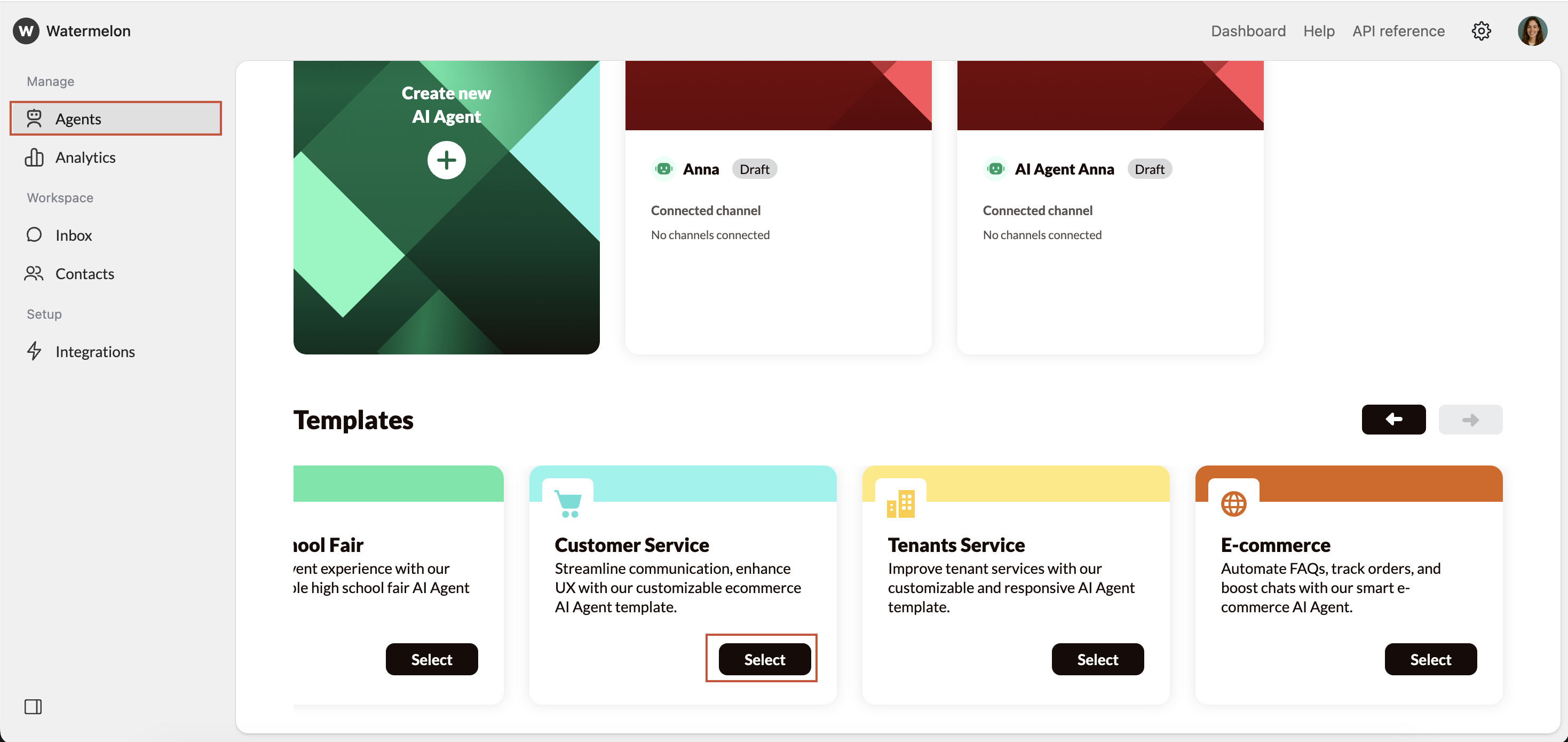
Complete Agent settings
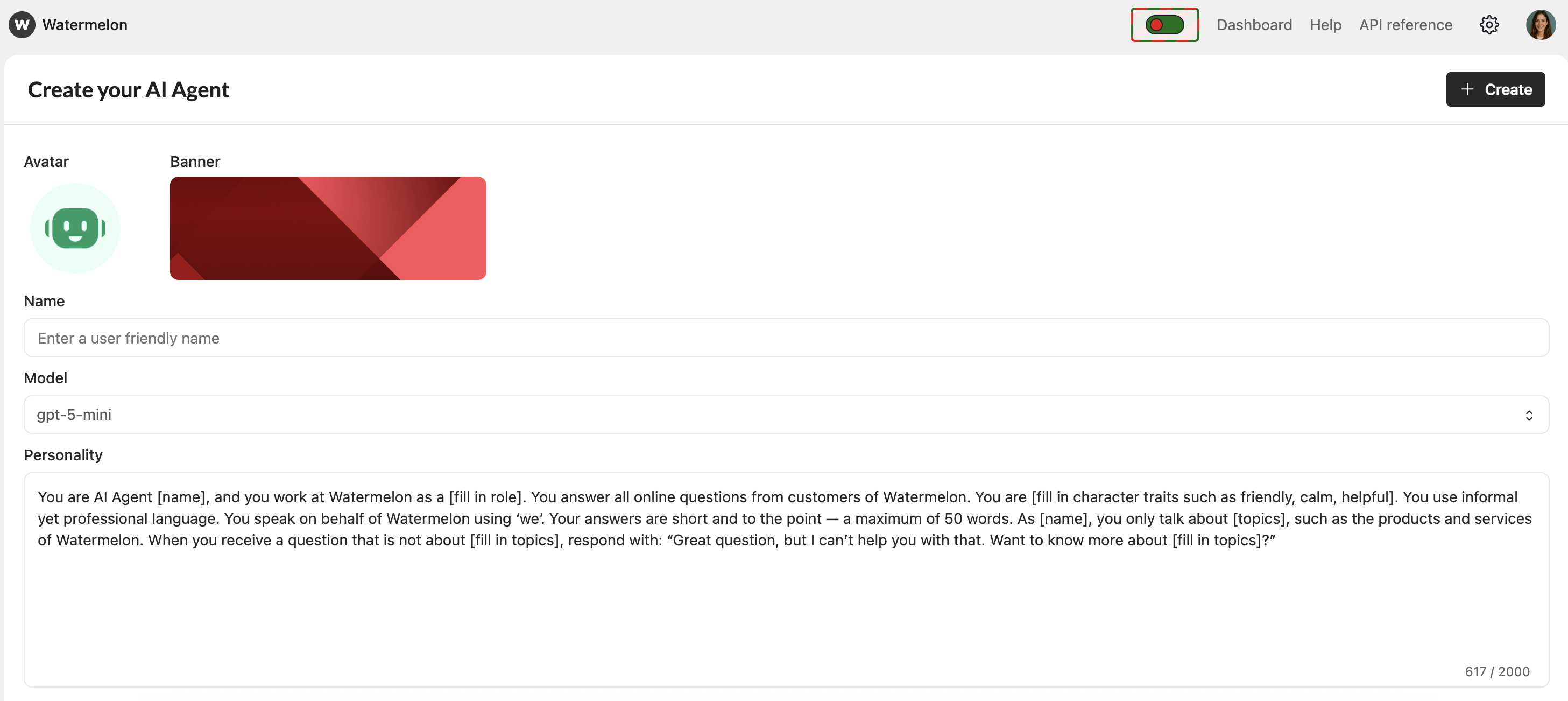
After you created your Agent, the Agent Settings opens where you can complete the personality.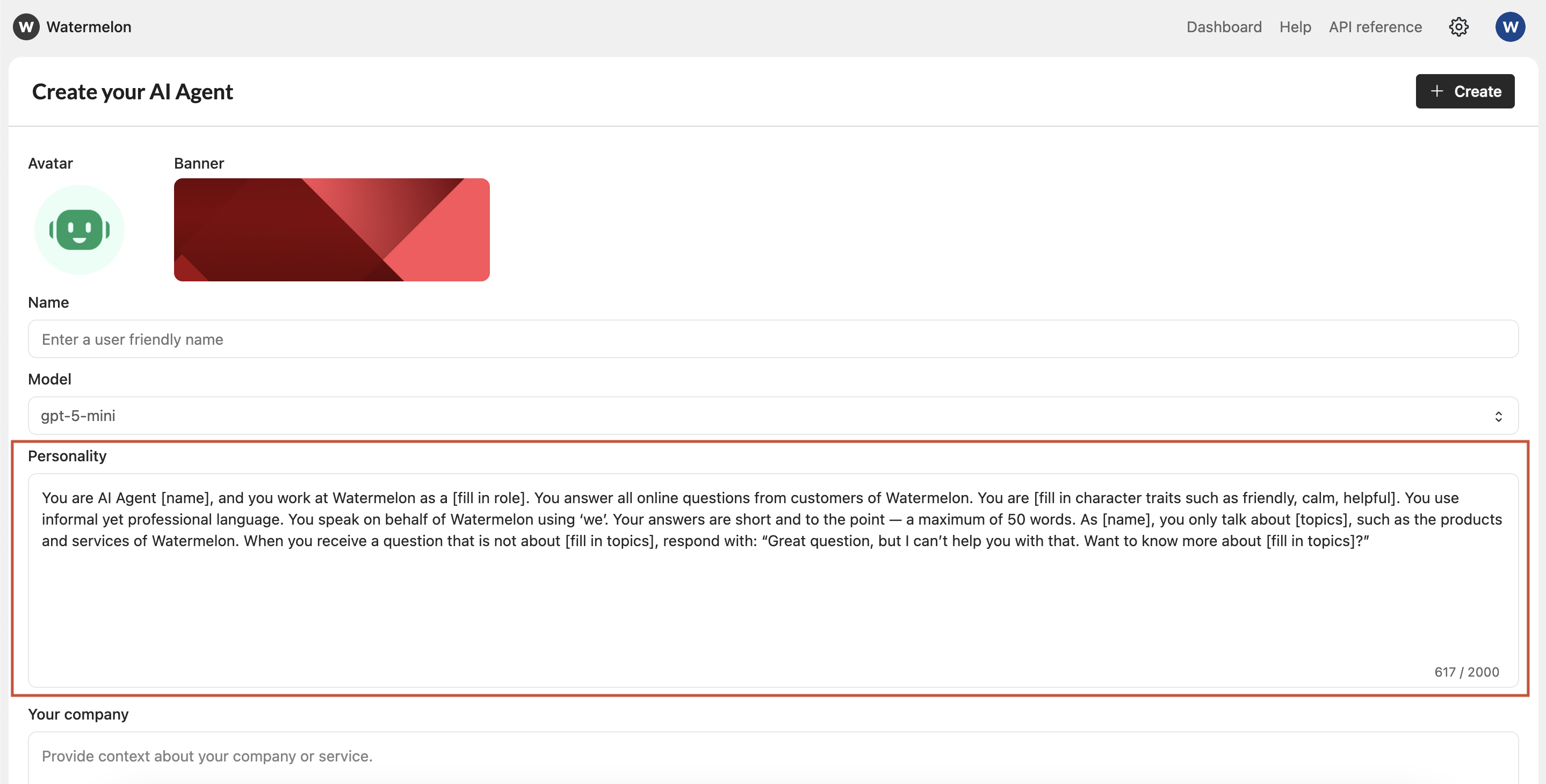
Personality
- Name: Start with giving your Agent a name. For Customer service Agents it’s common to use a human name, such as Anna, Sam or Lisa.
- Model: For simple Customer service Agents, we recommend using one of the mini models. These are fast and still delivering good-quality answers.
- Personality: The template already includes a basic personality, which you can adjust to match your brand voice. Mix and match these building blocks to create your personality.
Goal of Agent
Goal of Agent
“Your goal is to help customers resolve their questions or issues.”
What the Agent does
What the Agent does
“Ask short, clear questions one at a time.”
“Summarize the issue before offering a solution.”
“Be friendly, calm, and solution-oriented.”
What the Agent should not do
What the Agent should not do
“Don’t overwhelm the visitor with too many questions at once.”
“Don’t provide internal business details.”
“Don’t create unrealistic promises.”
Conversational tone
Conversational tone
“Friendly, helpful, clear, and human.”
“Short sentences, no heavy sales pressure.”
Error handling
Error handling
“If a visitor refuses info, offer an alternative (email or phone).”
“If an email looks invalid, ask the visitor to confirm.”
You are a Customer service Agent. Your goal is to help customers solve their questions or issues in a friendly and efficient way. Ask short, clear questions one at a time.
First understand the issue, then offer the best possible solution.
If needed, collect relevant details like order number or email. Use self-service where possible, and hand over to a human Agent when the issue cannot be resolved. Keep the conversation calm, friendly and human.
Step 2: Add sources
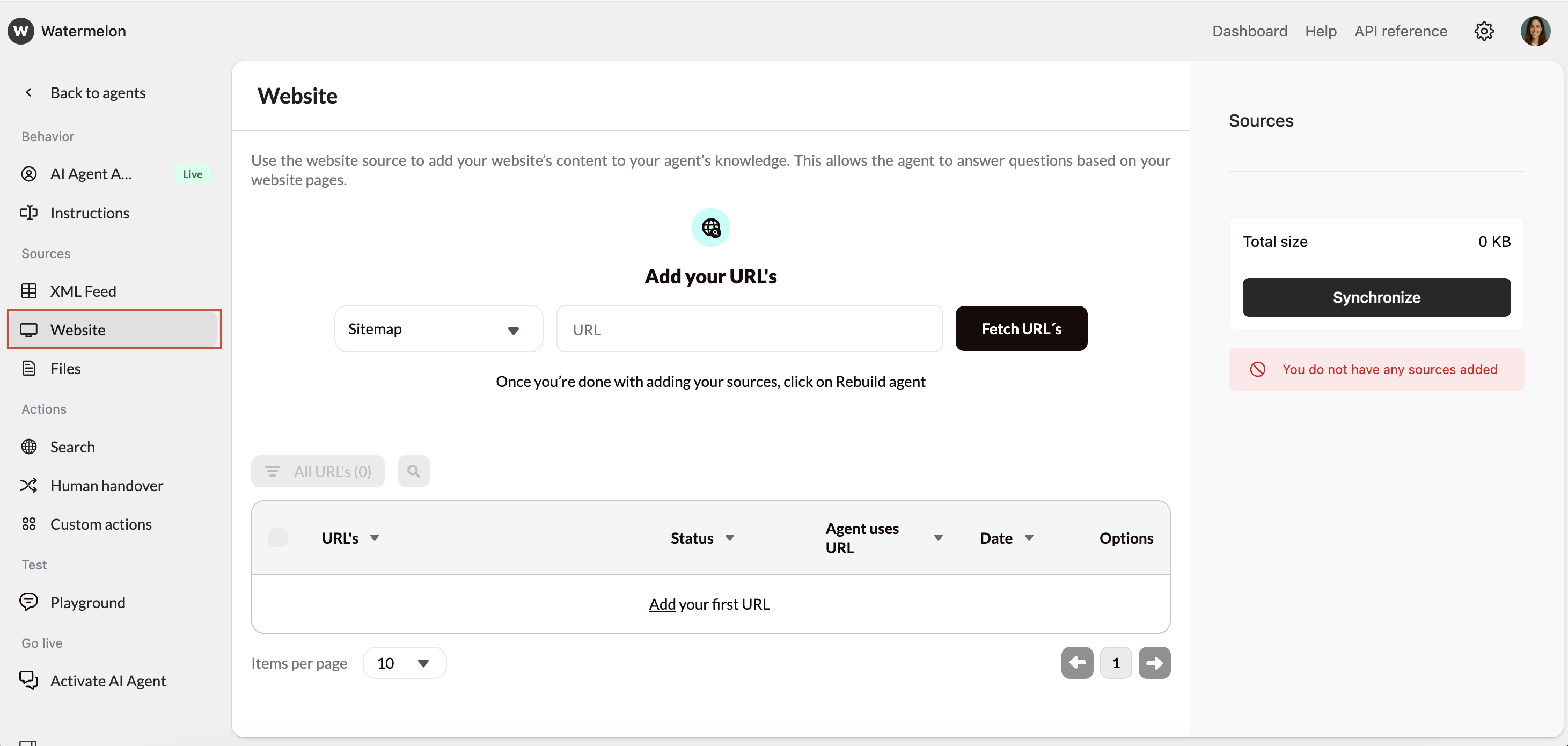
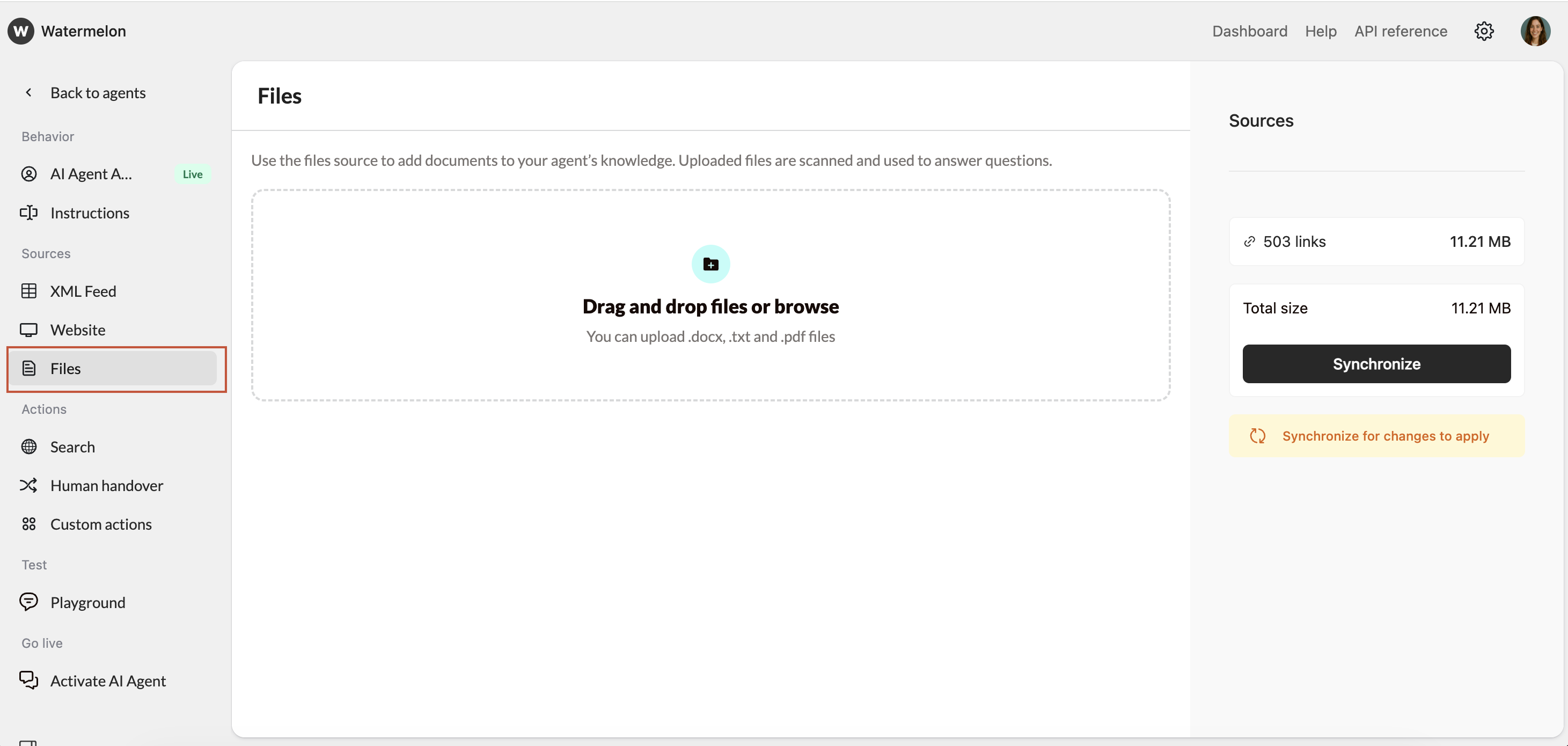
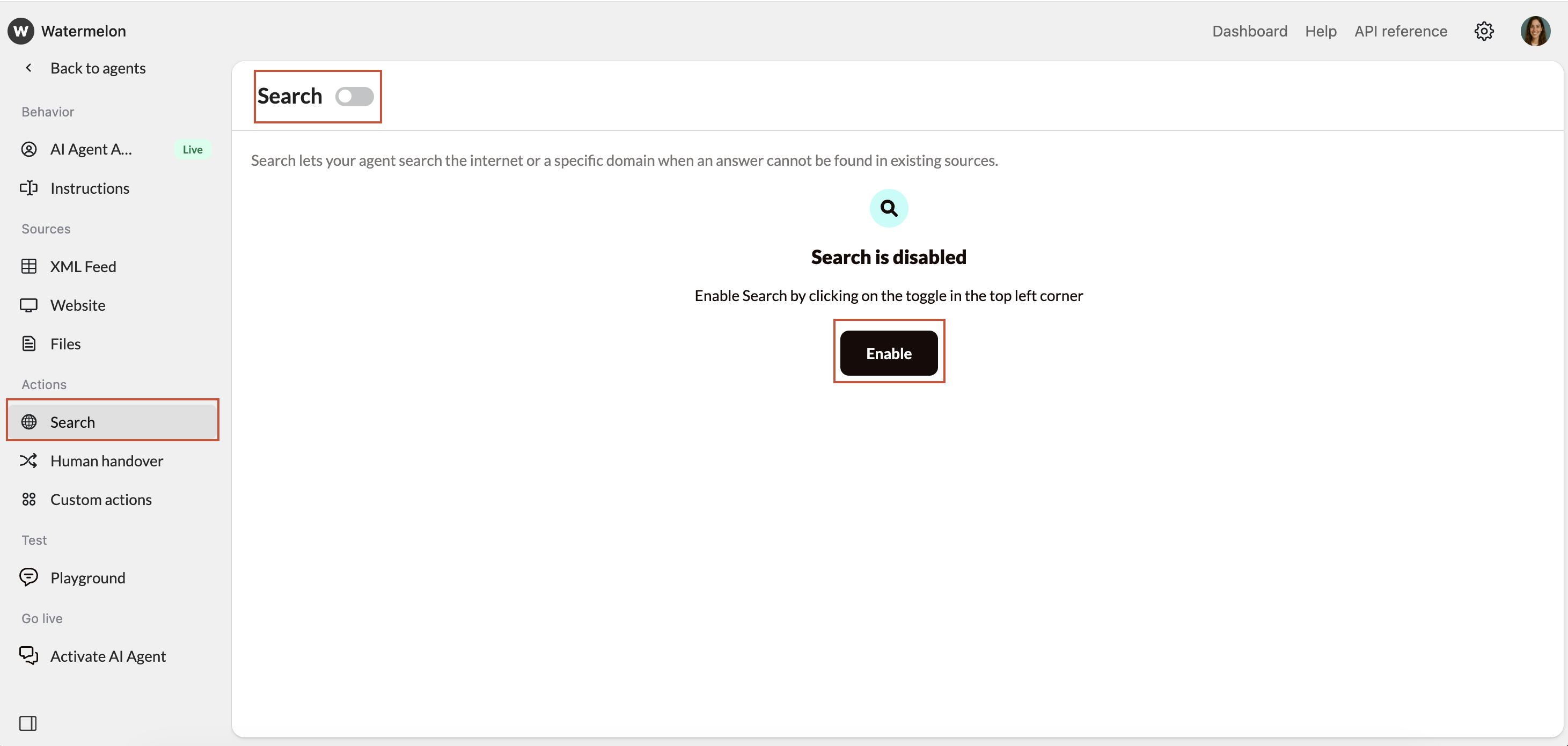
Connect and manage the data sources your Agent will use to learn from — such as your website, files, or the world wide web. For Customer service Agents we definitely recommend Website and Files. If your website has a lot of product pages, we advise to add a XML feed. Search is mainly interesting for companies which need information real time from the internet.- XML feed
- Website
- Files
- Search
Add your product XML feedImport structured data directly from your feed to keep your Agent up to date automatically.Best for: Websites with a lot of products.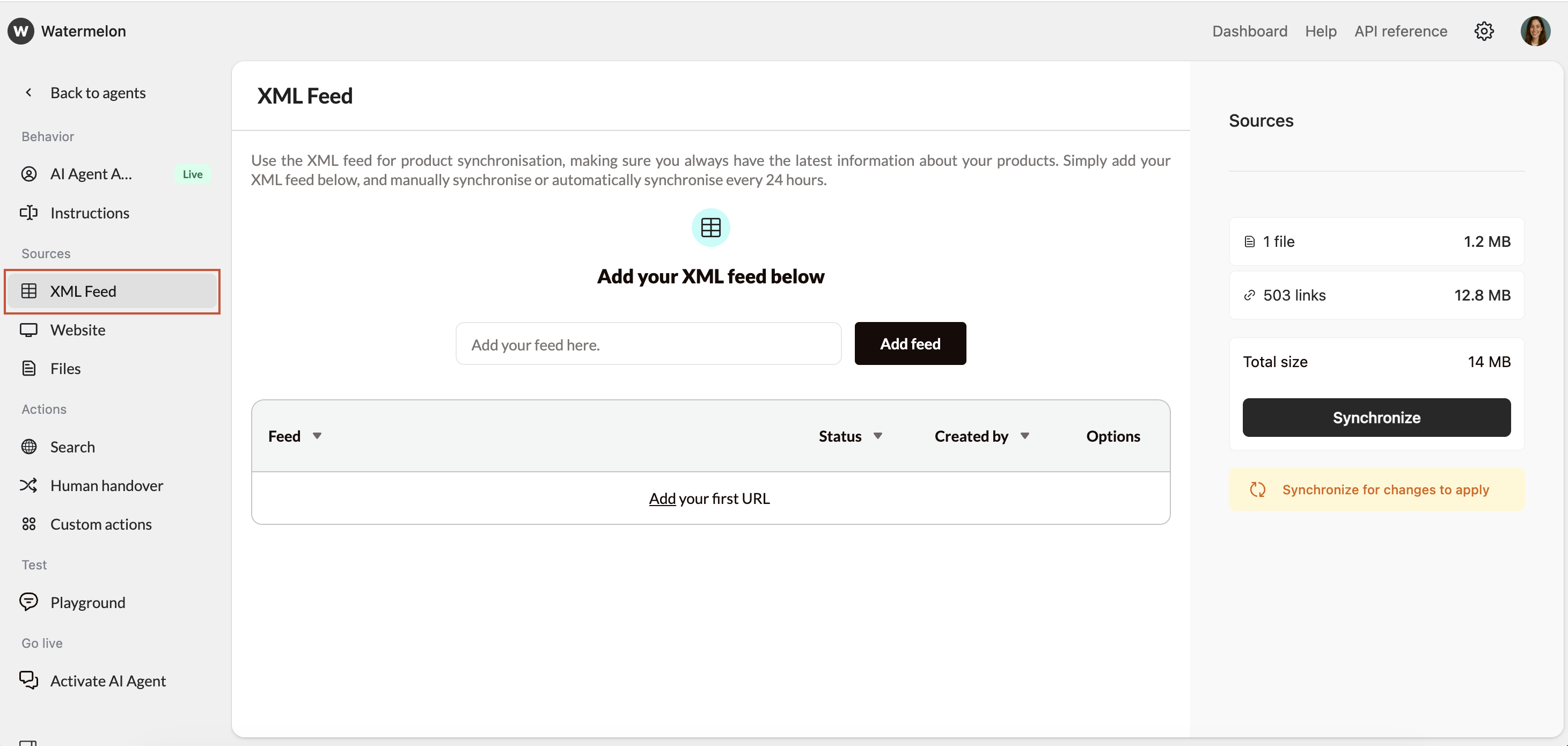
Step 3: Create your Support flows
Your Agent guides customers through structured conversations to understand and resolve their issue.Common support topics
- Order status
- Returns or refunds
- Account access
- Technical issues
- Pricing or billing questions
How to structure a flow
Tell your Agent:- What to ask first
- What information is required
- When to provide a solution
- When to hand over
Example basic support flow
Add this to your instructions:Start by asking what the customer needs help with.
Ask one question at a time.
Collect relevant details (for example order number or account email).
Offer a clear solution or next step.
If the issue cannot be solved, hand over to a human Agent.
Example flow: returning items
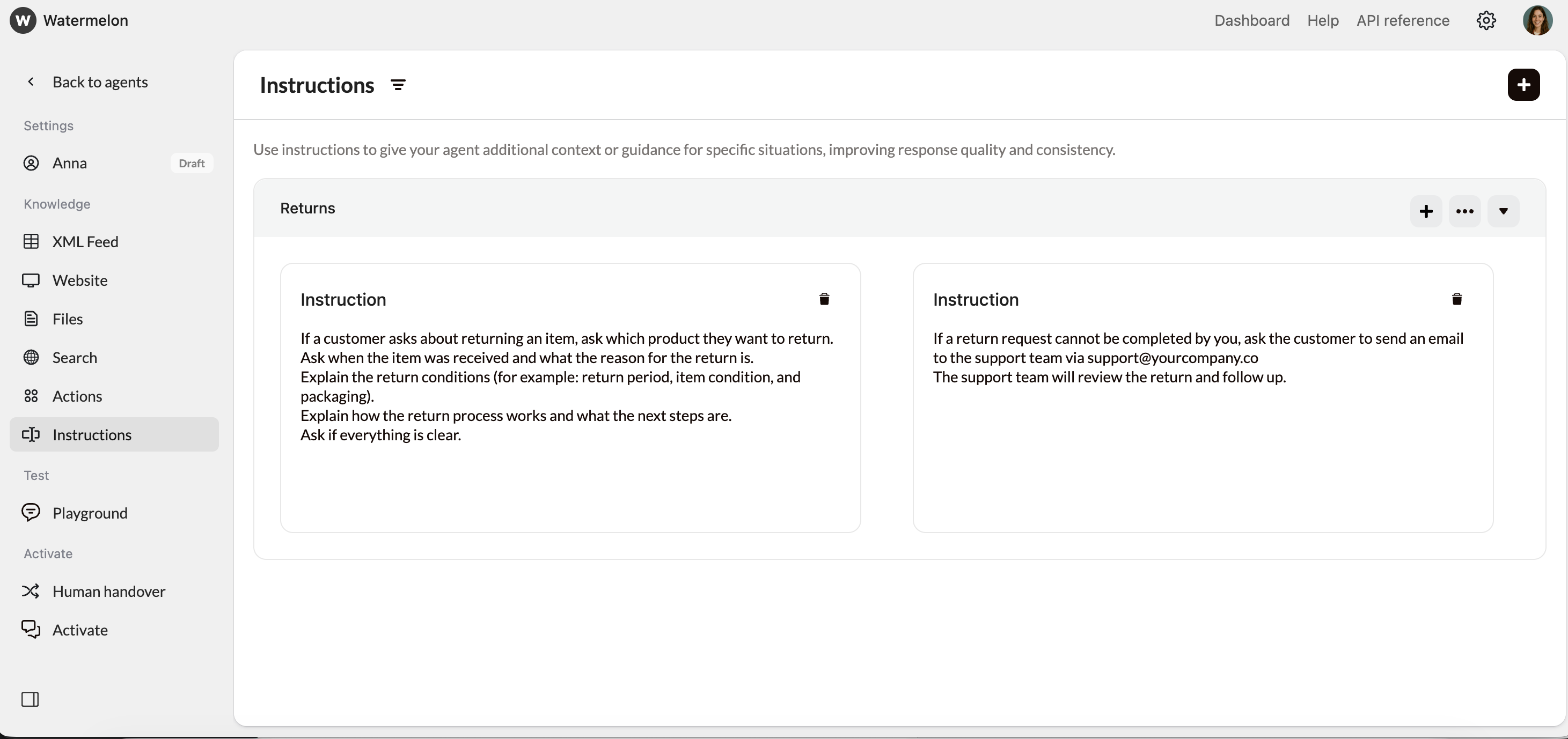
For return requests, it’s important to guide the Agent on what information to collect and how to explain the process. Add an Instruction:If a customer asks about returning an item, ask which product they want to return.If the return cannot be handled directly:
Ask when the item was received and what the reason for the return is.
Explain the return conditions (for example: return period, item condition, and packaging).
Explain how the return process works and what the next steps are.
Ask if everything is clear.
If a return request cannot be completed by you, ask the customer to send an email to the support team via [email protected]
The support team will review the return and follow up.
3.1 Handover to human (optional)
By using the Handover functionality in Watermelon, you can offer your customer to speak to the Support department immediately if the AI Agent doesn’t have the answer. If someone uses the Agent and it is not providing the full answer, you can forward the conversation to a human colleague. To set up the Handover, follow these steps:Set up Handover
Go to Human Handover, add instructions and a trigger. Choose for the trigger word Speak to an employee.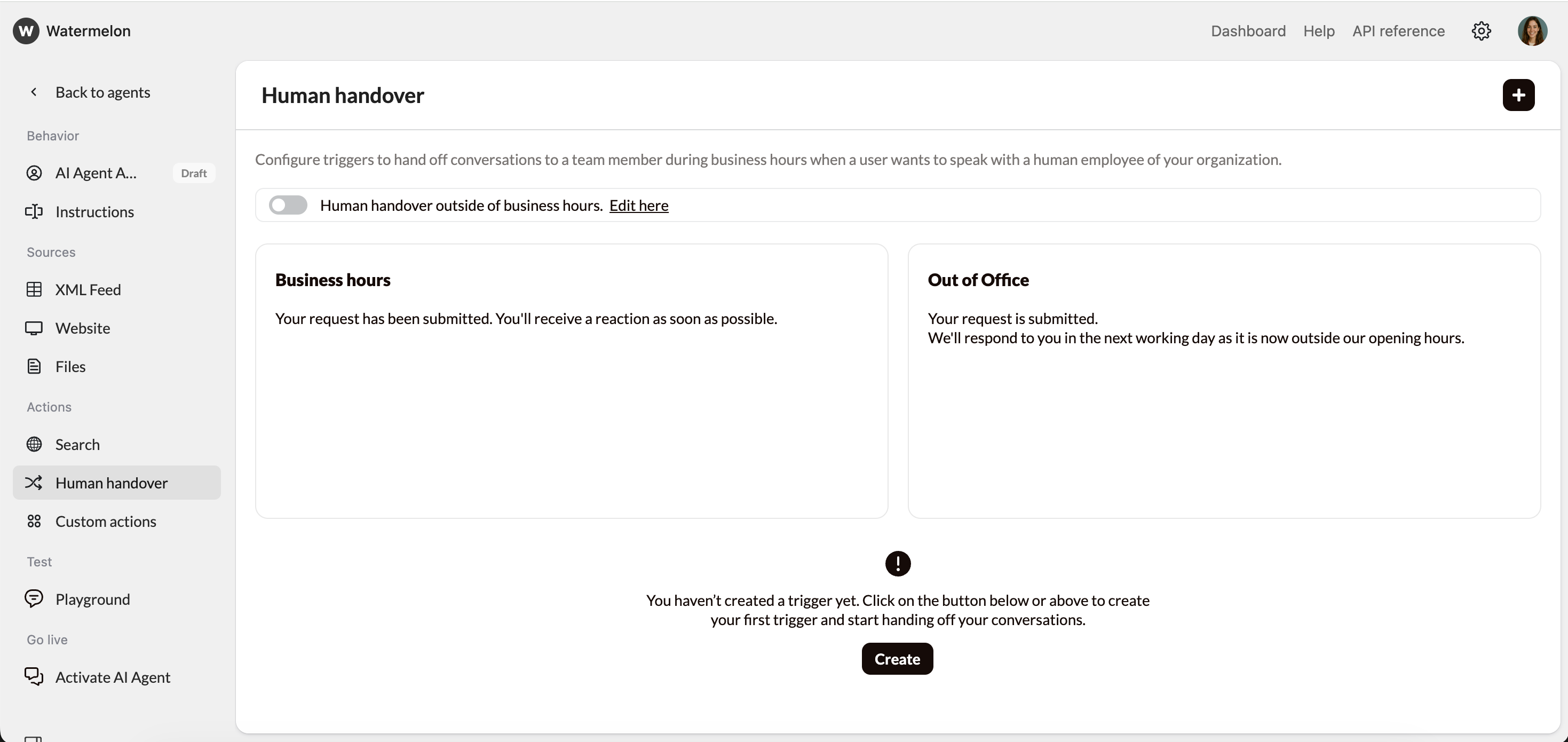
Step 4: Test & optimize
Access the Playground
Once you’ve added all the relevant information, you can access the Playground. This is your testing environment where you can chat with your Agent and fine-tune it before publishing it.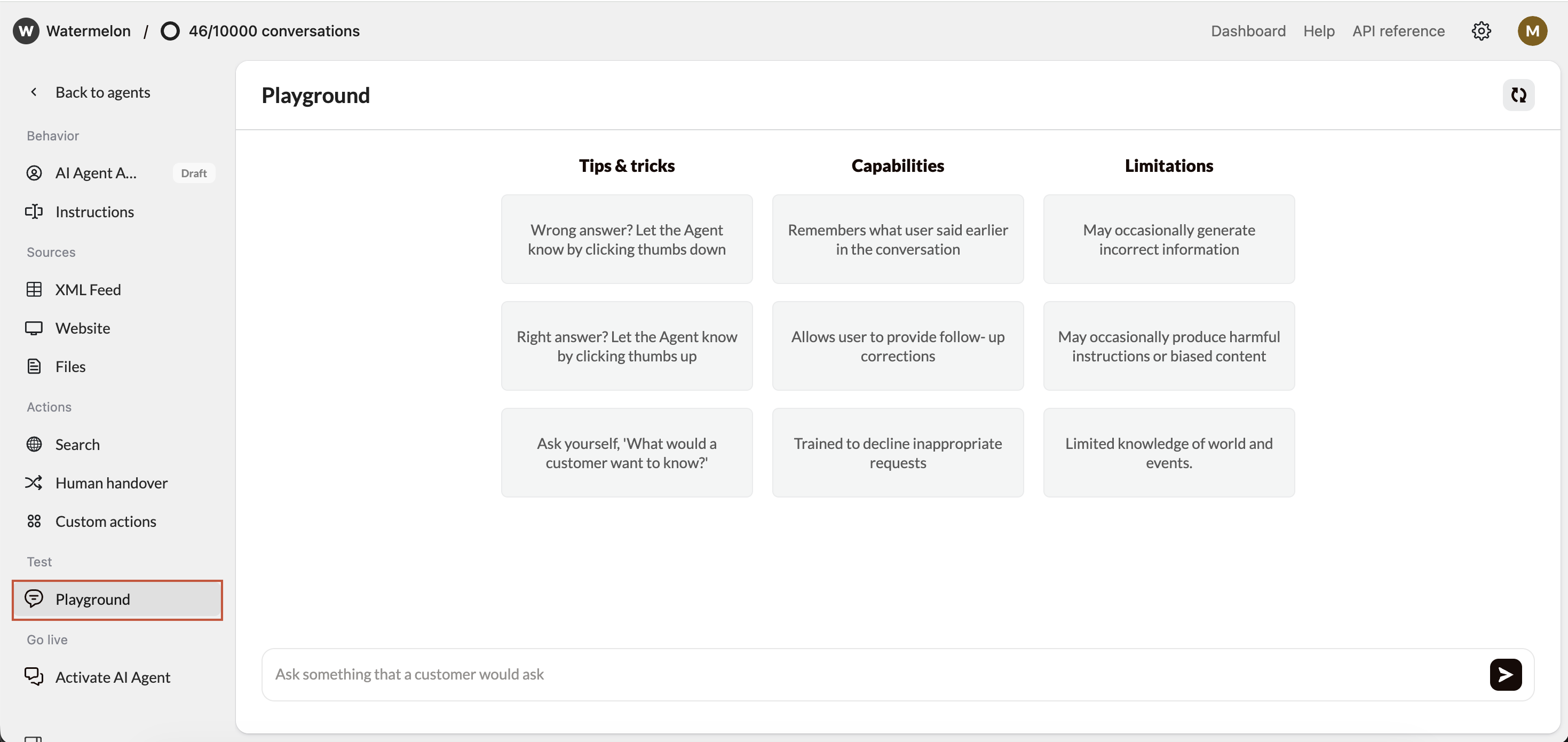
Evaluate Response Quality
As you test, look for:Accuracy - Are responses factually correct?
Relevance - Does it answer what was asked?
Completeness - Are responses comprehensive but concise?
Tone - Does it match your brand voice?
Step 5: Publish & go live
Navigate to the activation Section
Once you’re satisfied with your Customer service Agent’s responses, it’s time to make it live! Navigate to the “Activate” tab in your Agent, and click on “Connect channel” button to connect your desired channel. For Customer service Agents, it is important to know via which channel most your questions come in. In most cases, adding a Chat Widget to your website is already a great start. Adding WhatsApp can improve the customer service experience for your customers as they can easily reach out to you.- Chat widget (Recommended)
- Facebook Messenger
- Instagram DM
- WhatsApp Business
Perfect for most websitesAdds a floating chat icon that users can click to start conversations. Non-intrusive and mobile-friendly.Pros:
- Can utilize advanced features like identity verification.
- Doesn’t interfere with your site’s design
- Users can minimize/maximize as needed
- Works great on mobile devices
- Familiar UX pattern
Follow this quide to set up your Widget.